|
consider myself a lover of good food, a connoisseur of local markets, and
a sucker for fresh tart grapes and good cheese. However, sometimes I get a
little disappointed in myself for not expanding my cooking repertoire.
After all, how many times can one make chicken cutlets with skins-on mashed
potatoes and green beans in olive oil?
I told myself I'd buy more cookbooks, and even went so far as to peruse a
few, but the recipes all seemed so, well, inaccessible. They either
involved ingredients I'd never be able to find or kitchen appliances I
couldn't afford. But now, after reading In Helen's Kitchen: A Philosophy of
Food, I find myself re-energized, ready to scour markets for the smallest
courgette or the thickest slab of bacon, prepared to retire chicken cutlet
& co. for an extended period of time and begin a New Relationship With My
Kitchen.
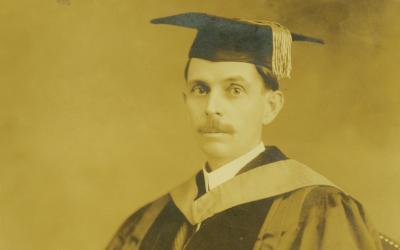
Helen Hudson Whiting '75 was, among other things, a bookseller and co-owner
of Durham's Regulator Bookshop, a reader, a writer, and an amateur chef.
For nineteen years, she wrote food commentaries for Triangle area
publications: first for WDBS-FM's The Guide, and then for The Independent.
In Helen's Kitchen, organized posthumously and edited by her friends and
colleagues, features an eclectic selection of these columns, as well as
remembrances from people who knew Whiting and cherished her enterprising,
adventurous culinary attitude and her zest for pleasure and her keen
intellect. Given this, the book is much more than a collection of recipes
to be used as a reference when one needs a good tomato sauce or cauliflower
curry-although it certainly serves such a purpose. It is a source of
tidbits on other cultures, advice on life in general, and, most of all, a
reflection of Whiting herself.
"The Traveling Stomach," a commentary dedicated to eating on the road,
features a recipe for travelin' iced tea, which Whiting proclaims "a
refreshing change from overdosing on cola." But it also lets us know that
she prefers "smaller highways" to "big interstates," and "regional dishes"
to "the usual burger and pizza chains." She encourages us to ask questions,
and look around a little: "That little local bakery might be full of real
cream- or custard-filled goodies or, on the other hand, the employees might
rival the chemists at Hostess."
This is not the only way that H. Hudson Whiting (her byline, adopted in
1978) challenges us to ignore our boundaries and move beyond what's
ordinary, both in eating and living. She admonishes us that there's no
excuse for eating badly: "IfŠyou think good cooking takes more time than
you can spare, remember that bad cooking takes time as well," she wrote in
a 1984 column for The Independent, "All Right, Campers! No More Excuses!
Into the Kitchen and Cook!" Time and again, she reminds us that to be a
good cook, you need to pay attention; purchase high-quality (though not
necessarily obscure) ingredients; own a sharp knife; and acquire at least
one good cookbook. "You don't need a kitchen full of gadgets," she writes.
Whiting's unpretentious and informative advice peppers these pages, if
you'll pardon the pun. She recommends the perfect dish on the day you've
just begun to recover from the flu (vinegar-splashed chicken), tells us why
not to be nervous when using yeast (just in case we were), and helps us
pack and plan our menus for tailgate parties (which, by the way, are also
perfectly acceptable to have when it's not football season). Eagerly, she
shares her favorite food writers, who included Elizabeth David and the late
Bill Neal '71, and encourages us to discover our own. Just when we're
beginning to feel a little intimidated (how could we ever know as much
about food as the late H. Hudson Whiting?), she comforts us with stories of
her own humble culinary beginnings: "Like most children I was conservative
about foodŠ. I tolerated the walnut as a lesser pecan and can only imagine
what I would have thought had I encountered the hazelnut, with a flavor nearly as distinct from other nuts as that of the almond."
In Helen's Kitchen is indeed a philosophy of food. It's also a catalogue of
Whiting's personal tastes, which range from the fiber-intensive (Margaret
Stewart's Refrigerator Bran Muffins) to the unusual (Badrijani Nigvis
Satenit-Russian for Eggplant Stuffed with Walnuts) to the tongue-in-cheek
(Pot Luck Brownies, alternately titled Brownies Like Your Mother Never Used
to Make). Whiting doesn't just give us a recipe for couscous; she explains
its origins (North Africa) and informs us that it's not precisely the name
of a dish, but rather of the grain itself. Then she provides an Algerian
recipe for couscous with chicken and lamb stew, given to her by a woman who
grew up in Algeria and, she writes, "is one of the best and most hospitable
cooks I've ever known."
In the column, "A Weakness for Chocolate," she educates us as to the
precious commodity's history, and reveals some surprising uses: in molé
sauce, which, in Mexico, is often served with turkey; and as the "secret
ingredient" in her mother's chili. Then she delivers some spectacular
recipes: sinful chocolate cake, chocolate mousse, hot chocolate, and the
mysterious-sounding chocolate chinchilla
-all of which I can't wait to try.
By the time I finished reading the book, I felt both chastened and
delightfully informed. On one hand, I had a pervading feeling of guilt-how
could I have been so lazy, for such an extended period of time? But on the
other, I had a sense of inspiration. Tonight, for sure, I'm going to make
the eggplant parmesan she describes on page 125, and perhaps, for dessert,
her apple pie.
Sadly, the inscription she wrote beneath her eggplant parmesan recipe-"H.
Hudson Whiting lives in Durham and frequently publishes favorite recipes in
hopes of encountering these dishes away from home"-no longer applies.
Though the world lost an incredible resource with her passing, I'll be
fondly thinking of Helen as I discover whether the dishes that were so
successful in her kitchen can pass muster in my own.
et me be up front about this. If you read Beautiful Work for the story, as
Doctor Johnson remarked of Clarissa, you might be compelled to hang
yourself. And while it contains some touching accounts of imagined
conversations that take place in a hospice, neither should you read it
because you're looking for a way to manage your or someone else's chronic
physical pain.
One might well read it for other reasons: Its ravishing prose simulates the
stream of incessant commentary, mystical dream, niggling argument, and
visionary rapture that characterize the experience of formal meditation. To
say that the author has convincingly captured her protagonist's interior
voices is no faint praise, for though such voices may not be inherently
instructive, they surely can be beautiful, decorous, aesthetically
pleasing. Fairly humorless, as sensitive as a mimosa, this is not, thank
God, another self-help book.
That said, what is it about? "I speak of the pain that has no cause,"
announces the narrator early on. And later: "Inside pain is the whole
world." Beautiful Work is far too unsystematic to be called philosophical,
too reminiscent of memoir to pass for fiction, yet too full of stealthiness
to read like nonfiction. The publisher labels it "belles-lettres/Eastern
philosophy."
In Eastern philosophy, pain leads straight to suffering-the ten thousand
attachments and aversions that keep us trapped just this side of nirvana in
an endless cycle of death and rebirth. The reality of suffering is such
that the wheel is never quite centered on the axle: "Anytime there is contact with the
ravishing world," Cameron writes, "there will be an impulse toward or away
from it." Meditation is the sword that separates pain from suffering.
This slim volume is an answer in search of a question. Neither dharma talk,
theological treatise, nor incantation, it partakes of all three. One might
call it a bildungsroman, a novel of education in which a naïve but
good-hearted heroine learns about the pitfalls of the world and how to make
her way safely among its snares. But then, I already said it wasn't
fiction. The progress of the action, such as it is, has to do with the
narrator's intellectual and spiritual journey through three meditation
retreats, in the course of which-with generous allowances for dreaming, the
winnowing of submerged memories, and the recall and amplification of
relevant leitmotifs-she comes to see the distinctions between pain and
suffering, awareness of thought and thought itself, indifference and
equanimity, pity and compassion. It is an account of the march toward
emptiness, the visceral mastery of the notion that self is a delusion, and
the ultimate reaching of escape velocity to take the narrator out of
history, especially her own.
Practitioners of meditation in the Vipassana tradition will love this book,
if they haven't already achieved enough equanimity not to love anything.
But one need not be a Buddhist, or even a student of Buddhism, to savor the
subtle beauties of its prose-the sound of a nun chanting in the Pali
language is "beautiful, like snow melting"-or the frisson occasioned by
unforgiving truths that leap off the page: "You have all your life demeaned
your life by making a story of it."
The urgency of one's stories, those contrived histories that create the
illusion of continuity and meaning in life, derives finally from excess
ego. To escape the self, we learn here, one must get beyond both despair
and hope, since the illusion of a separate self (along with the fact of
pain) is the precursor of suffering. Anna says, "I see that hope to perfect
the self hangs around my neck like the corpse of a dead animal." A hundred
pages later, she speaks for the last time of a dying animal in the wall
that, throughout her retreats, she has been sure is there, first crying and
hysterical, then by turns calm; an animal with which, in her dreams, she
learns to lie down.
Letting go of perfection means letting go of the self. Letting go of the
self leads to the letting go of suffering. Her accompanying
epiphany-enlightenment, rather-centers on the insight that "No one can free
himself from pain. But suffering is a house you can unbuild."
This is a difficult, taxing morsel, full of thoughtful and
thought-provoking cleverness for all its renunciation of the ravishing
world; it is a book full of sadness, masterful prose rhythms, and soulful
resonance. Although reading it can be frustrating, it is itself a beautiful
work that effervesces once you put it down.
|
![]()