|
THE INTERVENTION
Six days into 1995, Mike Krzyzewski struggled to get out of bed. Since his back surgery the previous October for a herniated disk, he’d given up racquetball but little else. The physical setback was an agonizing distraction to Krzyzewski, whose obligations and aspirations had accelerated exponentially since Duke’s back-to-back NCAA championships. Instead of taking it slow for the six- to twelve-week recovery period his doctors recommended, Krzyzewski threw himself right back into work—first at home, reviewing game videos until the early hours of the morning, and then, ten days after he got out of the hospital, back on the court.
As the team racked up six wins and one loss in November and December, Krzyzewski found himself in a constant state of exhaustion. He couldn’t sleep. The travel and logistics of an end-of-year trip to Hawaii for the Kraft Rainbow Classic left him physically and mentally drained. By the close of 1994, he’d lost fifteen pounds and couldn’t move without excruciating pain. On Monday, January 2, the Blue Devils beat South Carolina State. Two days later, they fell at home to Clemson, 75-70. On Friday, Krzyzewski could barely get dressed. Mickie had seen enough.
“It was horrible,” she recalls. “I don’t do ultimatums. But as he was walking out of the house, I told him that I had made a doctor’s appointment for him at 2:30 that afternoon, and he needed to be there. He said, ‘I have practice at 2:30.’ I looked at him and said, ‘Be at the doctor’s office or don’t come home.’ ”
Mike looked at Mickie. She held his gaze. He turned around and walked out the door.
As the morning gave way to afternoon, Mickie fretted. With no word from her husband, she drove to the appointment with a frantic mantra circling in her mind: please make him be here, please make him be here, please make him be here. She knew that if he didn’t show up, she would have to follow through on her threat. Please make him be here.
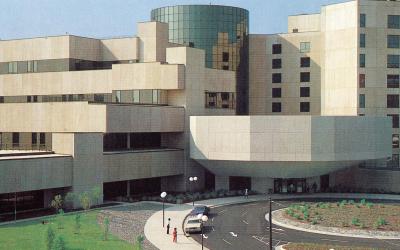
Krzyzewski’s orthopaedist was John A. Feagin Jr. M.D. ’61, whose office was in the Finch Yeager Building, overlooking Wallace Wade Stadium. As Mickie pulled into the parking lot, her eyes scanned the cars. She spotted Mike’s and succumbed to a wave of emotions—relief and gratitude, of course, but also fear. Fear of a dire diagnosis. Fear that he might lose his will or ability to coach. Fear of what might happen to him, to her, to their family, if he could no longer do the very thing that defined him professionally.
Mickie got out of her car and made her way to the exam room, where Mike was already waiting. He reached out and grabbed her hand. No words were spoken.
When Feagin walked into the room, he took one look at the hobbled forty-seven-yearold and knew the coach needed immediate help. Feagin had been the team doctor for the football and basketball squads at West Point when he first met Krzyzewski, then a nineteen-year-old point guard. The two men had developed a friendship that had spanned nearly thirty years. Feagin knew that there was more going on than physical distress. “When you are that immobilized with pain,” he says, “you don’t know if you have cancer and are going to die, or if you have surgery whether you will come back or not.” So Feagin—himself a West Point grad—framed his advice in a way Cadet Krzyzewski could grasp.
“You can’t survive at West Point without prioritizing,” says Feagin. “This was the first time that Mike had faced his own mortality, because the pain brought him to his knees. So we talked about getting his priorities straight—and getting well was the top priority.”
But Mickie wasn’t taking any chances. She staged an intervention that included Feagin and three people she knew her husband respected—psychiatrist Jean Spaulding M.D. ’72, former Duke president and psychiatrist Keith Brodie, and Center for Living director and nephrologist James Clapp. “There were five us, like a basketball team,” Mickie says. “One on one, Mike can be stubborn or intimidating or combative, but there were five of us on the team, and he couldn’t win. We put him in the hospital that night.”
On January 22 that year, Krzyzewski told his team he would be out for the rest of the season. He offered his letter of resignation to Butters, who refused to accept it. But he was not a compliant patient. “He was just miserable,” says Mickie. “It was not a good time. It was not relaxing, and it wasn’t pleasant. And then Duke went on a slide and the team started losing. He felt so guilty about that. Here he was, the military officer who had deserted his troops in the midst of the war. He was killing himself over that.”
The most frightening aspect of that period, says Krzyzewski, was the complete absence of vitality. “Usually I can snap back,” he says. “I mean, I’m on all the time. But I was drained. I didn’t have any energy or any feeling. How do you fight without those two things? The two major things I needed were missing, and I didn’t know if they would come back.” He also was haunted by the loss of his close friend Jim Valvano, who had died of cancer just two years earlier. Valvano had been hired by N.C. State in 1980, the same year Krzyzewski came to Duke—two Northerners, a Pole and an Italian, shaking up the South—and the two had forged a bond that transcended basketball.
It was obvious that Krzyzewski needed to rethink how he ran his program and, by extension, his life. At Mickie’s urging, he took up gardening. Time-management experts were consulted. Additional staff members were hired at the basketball offices to handle the program’s increasingly complex logistics. New phone systems were installed. Krzyzewski embraced the idea that in order to make his program successful for the long haul, he could no longer be responsible for every aspect.
“If you had a wheel, with spokes all coming out of the center, that was the way I ran my program,” he says. “I was the center of the wheel, and everything ran though me. When I was knocked out, when the center of the wheel goes, the wheel goes. Quite simply, this is how I changed. I built a new wheel, and I connected this point with that one and that one with this one. Some of them went through me. But you could take me out—are you getting the visual here?— you could take me out, and it would still work. Once I figured that out, it helped me immensely.”
Winter turned to spring. Krzyzewski grew stronger. His energy returned and his excitement to get back in the game was more intense than ever. His friend John Feagin recalls a line from Hemingway’s A Farewell to Arms: “ ‘The world breaks everyone and afterward many are strong at the broken places.’ That experience made Mike stronger.”
“It’s too easy to say that I micromanaged or didn’t delegate enough,” says Krzyzewski. “I don’t believe in the word delegate. I believe in the word empower. I was not empowering people before, but once I connected the spokes in a different way, it became everyone’s wheel. That’s why we’re so good now. We’re better than we were then. I’m better. And that will never happen to me again. More important, it will never happen to our program again.”
THE DUKE BRAND
In the summer of 2004, word spread like wildfire that the Los Angeles Lakers had offered Mike Krzyzewski a five-year, $40 million package to leave Duke and join the pros. Coach K had entertained other overtures, from the Celtics in 1990 and the Trailblazers in 1994. But this was the Lakers, one of the most successful teams in the NBA, led by Kobe Bryant, whom Krzyzewski had recruited in high school. The prospect of losing Coach K sent fresh waves of panic throughout Devildom.
Conspiracy theorists argue the Lakers offer was timed to make new President Richard H. Brodhead assure Krzyzewski of his estimable position in the university hierarchy. But the interest from Lakers general manager (and former UNC standout) Mitch Kupchak was genuine. Bryant, who had remained close to Krzyzewski through the years, called to encourage him to consider the offer.
Even in the midst of those early turbulent years at Duke, Krzyzewski had never been tempted to consider moving to another university. But the prospect of coaching some of the best professional players in the world was a powerful enticement at that moment in his life. After consulting with his family and a handful of friends, including Tom Butters, Krzyzewski decided to turn down the offer. “Duke has always taken up my whole heart,” he explained at the time. (The following year he would get his shot at coaching the pros, including Bryant, when he was named head coach of the USA Basketball men’s team.)
Krzyzewski knows that there are those who decry the fact that he is better known—and is now better paid—than any of the four Duke presidents he has served under. A Google search on “Coach K” yields more results—17 million and climbing—than those of Terry Sanford, Keith Brodie, Nan Keohane, and Richard Brodhead combined. It’s a distinction he doesn’t take lightly. “Duke branded me. It gave me prestige,” he says. “I’m the Duke coach, so no matter what, I am affiliated with an outstanding university. I am Duke every second of my life. That’s a big responsibility but also a big honor.”
Whenever Krzyzewski talks to faculty members, he emphasizes that “Duke basketball is not the most important thing here. I know that. I work for Dick Brodhead and [athletics director] Kevin White. But Duke basketball is the biggest marketing arm of this university.”
Think about walking down Fifth Avenue during Christmas time, he says. It’s magical. You get to Saks Fifth Avenue, and the breathtaking window displays stop you in your tracks. “You look at them and say, wow! How did they do that? So you walk in the store and you go to the first floor, the sixth floor, the seventh floor. Well, we’re the window of our university. We bring a lot of people in, and then they find out what’s happening in medicine, law, business, history, English. As long as we understand that, and use it, it’s nothing but good. I’ve understood that from the get-go. Getting the right people to come in the door opens up development, research, faculty wanting to be here, recruitment, enrollment— look, it opens up everything. We know we’re part of that team.”
To capitalize on Duke basketball’s success, Krzyzewski helped launch the Legacy Fund. Established in 2000 and chaired by Grant Hill ’94, the Legacy Fund is an effort to fully endow the basketball program as well as capital improvements to basketball facilities. The Krzyzewskis donated $1 million to the fund in honor of Mike’s brother Bill, who retired from the Chicago Fire Department at the rank of captain. To date the fund has raised more than $60 million, enough to endow twelve scholarships, a graduate coaching position, two student managers, and an assistant coach. Proceeds from the K Academy fantasy camp also are directed to the fund.
“I want to make sure that when I’m gone,” he says, “the wheel keeps rolling.”
|